Ginzburg-Landau theory of Multi-q Magnetism
Author: Dmitri LaBelle, Advisor: Jörn Venderbos Drexel University, Department of Physics
Funded by The Office of Undergraduate Research
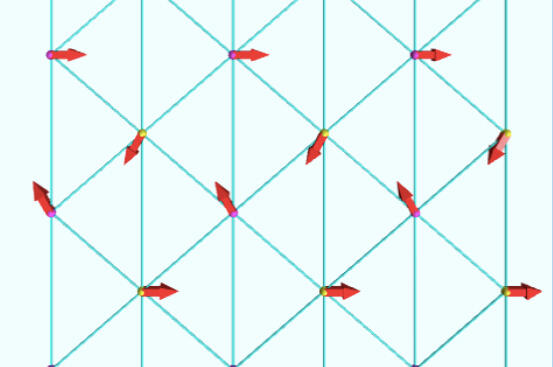
Background
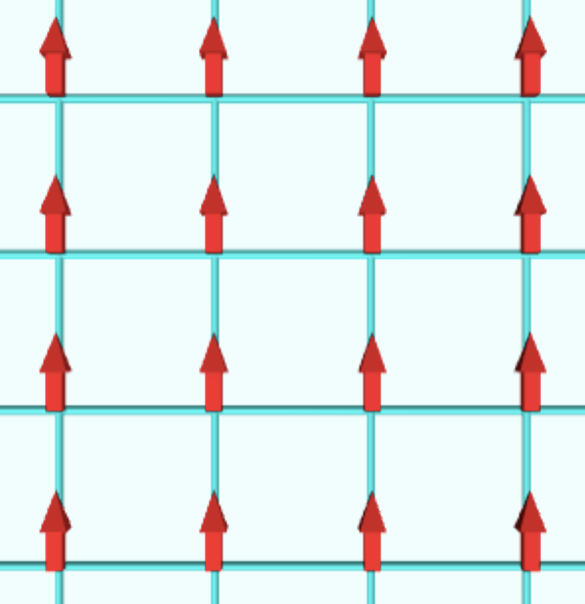
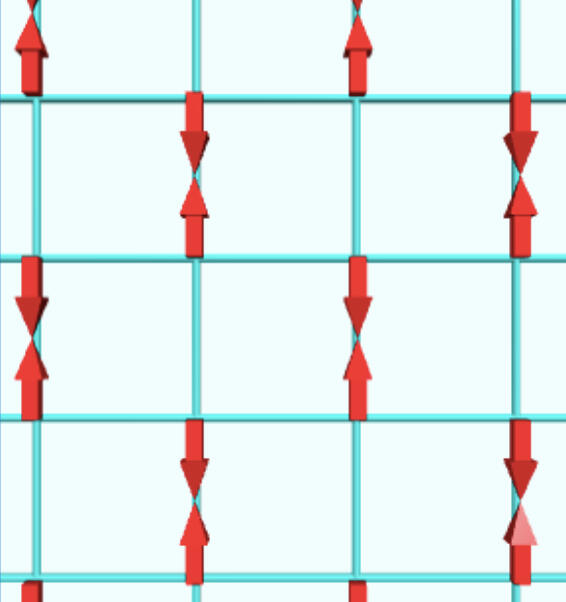
Conventional magnets work by having the spins of electrons aligned in the same direction in each atom of the magnetic material, this is referred to as Ferromagnetic. When the direction of spins alternate in opposing directions, this is referred to as Anti-Ferromagnetic.
Project Proposal
Besides just ferromagnetic and anti- ferromagnetic states there can also be a plethora of other spin configuration ground states. But there has yet to be a concise way to find them, and usually takes case by-case mathematical analysis. By utilizing known proprieties of the material such as the free energy equation and the lattice structure we can discover possible ground states.
Methods
Review/ Confirming Findings of Other Papers
This process allowed the author to familiarize themselves with common conventions of condensed matter physics and introduced a basis for the symmetry based algorithm.
Exploration of Mentor Proposed Problems
An investigation of the hexagonal lattice system using the free energy expansion method, and octahedral 3D lattice using the proposed symmetry based algorithm.
Results
Using the free energy method the author was able to show the existence of triple-q ground states in the hexagonal lattice. Furthermore solving that a triple or single-q ground state is always energetically favorable in comparison to a double-q state. The author was also able to reproduce results from the preliminary lattice symmetries paper for the triangular lattice, indicating promising prospects for the primary investigators proposed algorithm.
Conclusion
The symmetry based algorithm has shown promising results with 2D and 3D regularly ordered lattices and has risen more potential questions related to ordered ground states within magnetic lattices.
Future Work
This research stands to advance our general understanding of complex ordering phenomena in strongly correlated magnetic materials. Such understanding could help provide the building blocks for new and potentially more robust magnetic storage devices/ quantum information storage. This would allow for more information to be stored in less space then modern data chips.